Sodium channels as analgesic targets
Voltage-gated sodium (Nav) channels are essential for the initiation and propagation of action potentials in excitable cells, including neurons, muscle fibers and selected endocrine cells.
Of the nine sodium channel subtypes found in humans (Nav1.1–Nav1.9), three - Nav1.7, Nav1.8 and Nav1.9 - play key roles in pain signaling.
We offer high throughput screening studies on Nav1.7, Nav1.8 and Nav1.9 with automated patch clamp systems and additionally gold standard assays with manual patch clamp accounting for channel state specific interactions. Counter screen for interaction with other sodium channel subtypes are part of lead optimization.
Based on the many years of experience of our ion channel specialists, additional assay protocols are used in the characterization of inhibitors, which take into account specific interactions with different channel conformations (resting, open, and inactivated).
Nav1.7
Nav1.7 Highly expressed in peripheral nervous system (PNS), especially in nociceptive (pain-sensing) neurons of the dorsal root ganglia (DRG) and sympathetic ganglia. Little to no expression in CNS neurons, skeletal muscle, or cardiac tissue — which reduces systemic toxicity risk for inhibitors compared to other Navs (e.g. Nav1.5 in heart or Nav1.4 in muscle).
Nav1.7 activates at more negative voltages than other sodium channels which can amplify small, slow depolarizing inputs in sensory neurons until the threshold of excitation. Once threshold is reached, other channels (like Nav1.8 and Nav1.9) support generation of action potentials.
Sodium channel inhibitors can bind with different affinities to the channel in the resting (closed), open (activated) and inactivated (closed) states (referred to as a state-dependent block).
Tool Compounds
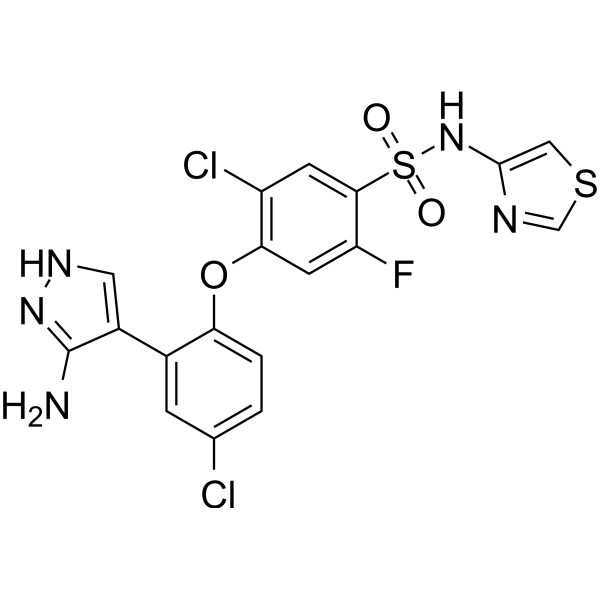
PF-05089771
Reference Inhibitor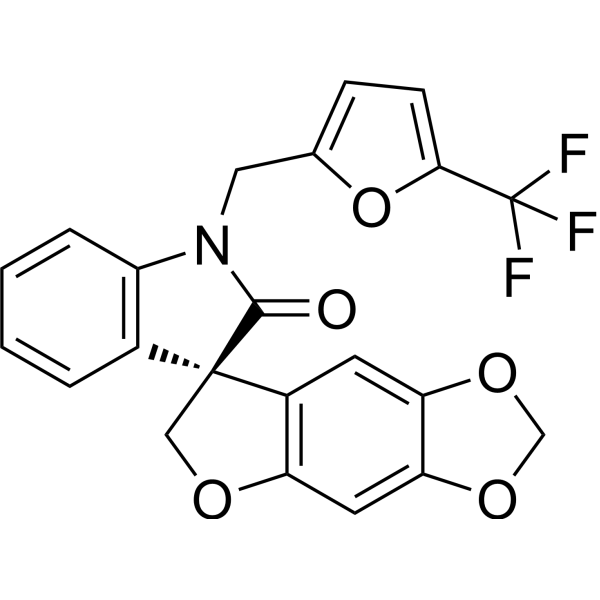
Funapide (XEN402)
Clinical CandidateNav1.8
Nav1.8 is expressed almost exclusively in peripheral sensory neurons of the dorsal root ganglia (DRG) and trigeminal ganglia—particularly in nociceptive (pain-sensing) neurons. Data suggests that it is not expressed in CNS neurons or cardiac muscle.
Nav1.8 activates and inactivates at more depolarized membrane potentials than TTX-sensitive Nav channels (Nav1.7). Other hallmarks are its slower inactivation but fast recovery from inactivation. These properties facilitate repetitive firing of action potentials and associated pain signaling.
Tool Compounds
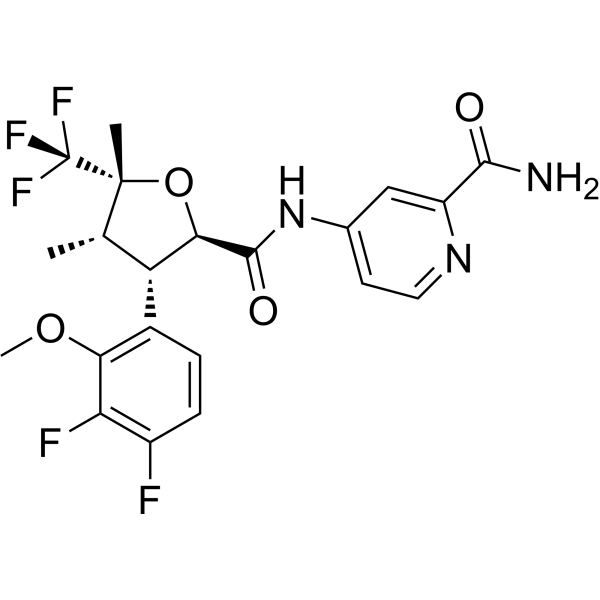
VX-548 (Suzetrigine)
First-in-class selective Nav1.8 inhibitor approved for acute pain. Demonstrates the clinical validity of the target.
Other Clinical & Tool Compounds
Tool Compounds
VX-548 (Suzetrigine)
First-in-class selective Nav1.8 inhibitor approved for acute pain. Demonstrates the clinical validity of the target.
Other Clinical & Tool Compounds
Nav1.9
Nav1.9 are predominantly expressed in small-diameter dorsal root ganglion (DRG) and trigeminal ganglion neurons, especially nociceptors, while expression in CNS, skeletal muscle, or cardiac tissue is minimal minimizing off-target effects for selective modulators.
Nav1.9 activates at very negative (hyperpolarized) voltages (around −70 mV) and has slow activation and inactivation kinetics (compared to Nav1.7/1.8). Its "non-inactivating current" produces a sustained sodium leak current that contributes to the resting potential.
ChanPharm’s assays on Nav1.7, Nav1.8 and Nav1.9
ChanPharm uses special protocols for the analysis of state-dependent effects, which enable a clear distinction between the respective interactions with resting, open, and inactivated channels. Please contact us for further information.
We offer high throughput screening studies on Nav1.7, Nav1.8 and Nav1.9 with automated patch clamp systems. Selectivity of potential drug candidates is analysed by counter screening against the other 6 Navs. Available cell lines for automated drug discovery on Nav1.1 – Nav1.9
Screening Platforms & Technologies
SyncroPatch 384
Ion channel screening at scale.
The SyncroPatch 384 is a high-throughput automated patch clamp platform optimized for large-scale ion channel screening. It enables parallel recordings from hundreds of cells, allowing rapid assessment of compound potency, activity, and selectivity across ion channel targets.
This platform is ideal for hit identification, lead prioritization, and early safety profiling where speed, robustness, and data consistency are critical.
Best suited for: Primary screening, hit confirmation, potency ranking, early off-target assessment
NANION TECHNOLOGIES HIGH THROUGHPUT
Patchliner
High-quality functional profiling with automation.
The Patchliner provides medium-throughput automated patch clamp recordings with excellent gigaseal quality and high data fidelity.
It is well suited for detailed ion channel characterization, including concentration–response studies, state dependence, and mechanism-of-action analysis, bridging high-throughput screening and manual electrophysiology.
Best suited for: Secondary screening, lead optimization, mechanism-of-action studies
NANION TECHNOLOGIES MEDIUM THROUGHPUT
Manual Patch Clamp
Gold-standard ion channel electrophysiology.
Manual patch clamp provides unmatched experimental control and resolution for studying ion channel function.
This approach is used for complex protocols, detailed kinetic analysis, and challenging targets where maximum data quality and flexibility are required.
Best suited for: Detailed kinetics, complex protocols, validation of screening results
CONVENTIONAL SYSTEMS GOLD STANDARD