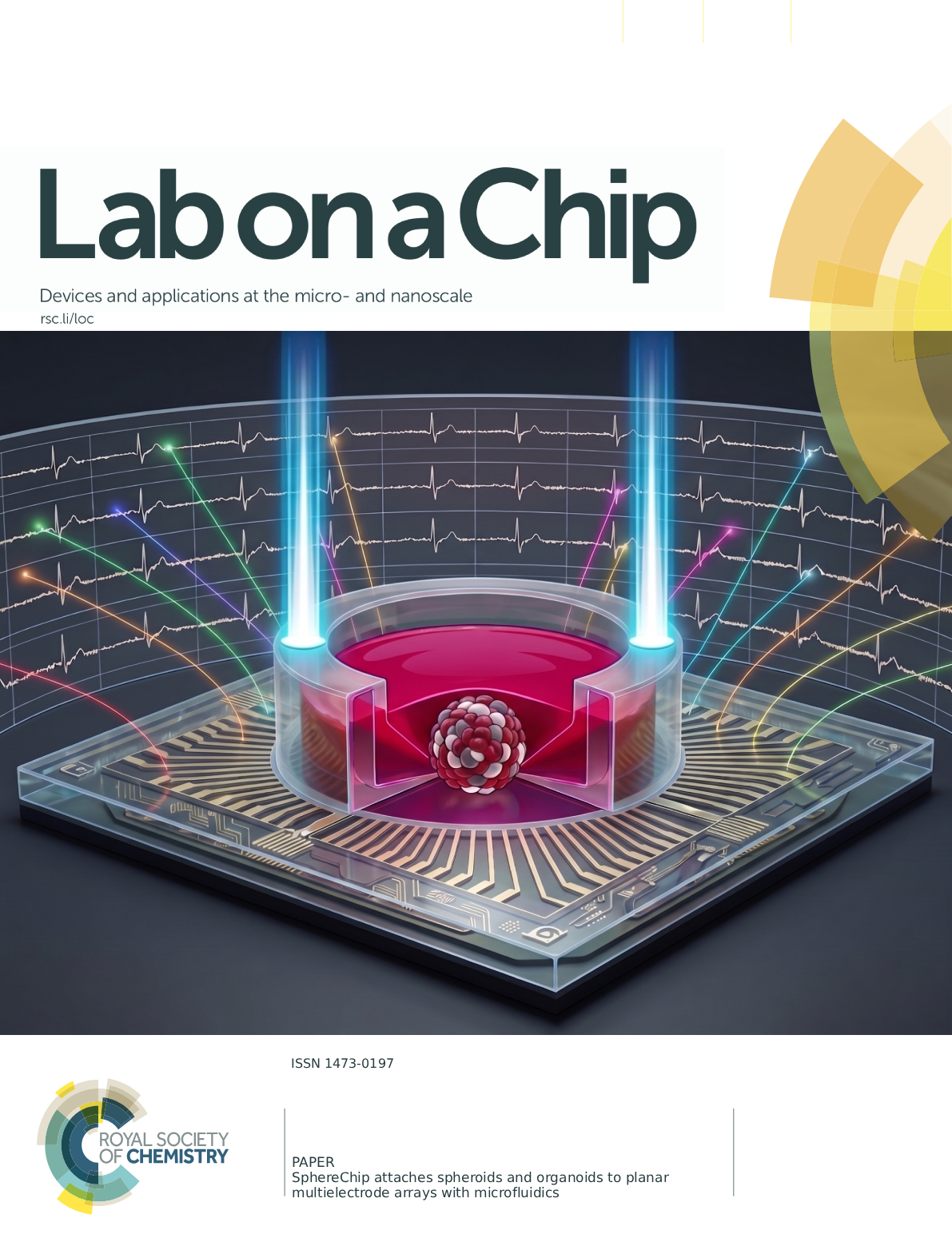
ChanPharm introduces CP:SphereChip™ technology for electrophysiological studies of human 3D cardiac and neuronal models — a new microfluidic platform, published in Lab on a Chip, that enables substantially enhanced field-potential recordings, simultaneous functional imaging and controlled drug application in spheroids and organoids.
ChanPharm GmbH, a Vienna-based provider of advanced electrophysiology and drug-discovery services, today announced the publication of its proprietary CP:SphereChip™ technology for functional studies of human cardiac and neuronal spheroids and organoids in the Royal Society of Chemistry journal Lab on a Chip.
The peer-reviewed study, “SphereChip attaches spheroids and organoids to planar multielectrode arrays with microfluidics,” describes a new approach for overcoming one of the key technical challenges in electrophysiological studies of three-dimensional cell models: establishing stable contact between a round, free-floating spheroid or organoid and the flat electrodes of a conventional multielectrode array (MEA).
SphereChips precisely control microfluidic suction to position a spheroid or organoid directly over the recording electrodes within minutes. This creates stable tissue-electrode contact, reduces movement artefacts and substantially improves electrophysiological signal quality. The study demonstrated that, in cardiac spheroids, field-potential amplitude increased by approximately sevenfold on Multi Channel Systems and Axion Biosystems MEAs compared with conventional overnight attachment on fibronectin-coated MEAs.
Importantly, the platform enables electrophysiology and functional imaging to be performed on the same 3D preparation. In cardiac models, field potentials recorded by the MEA can be analyzed together with fluorescence-based measurements of action potentials, intracellular calcium dynamics or contractile activity. On compatible transparent MEA platforms, the microfluidic design therefore permits direct correlation of electrical and optical readouts from the same spheroid or organoid.
A further key feature is controlled compound application. Once positioned, the 3D model remains in stable contact with the electrodes during rapid exchange of the surrounding test solution. This enables concentration-response and wash-in/wash-out experiments without repeatedly repositioning the biological sample — an important advantage for pharmacological research and safety testing.
In the published proof-of-concept experiments, SphereChips were successfully applied to human stem cell-derived cardiac spheroids, neuronal spheroids and larger cardiac organoids. Cardiac studies demonstrated concentration-dependent effects of the proarrhythmic potassium-channel blockers E4031 and dofetilide on action- and field-potential duration. In neuronal spheroids, pharmacological modulation of potassium channels produced concentration-dependent changes in spiking and bursting activity.
Human iPSC-Derived 3D Models from FUJIFILM Cellular Dynamics
Human iPSC-derived cells and 3D models from FUJIFILM Cellular Dynamics, Inc. played an important role in establishing the cardiac and neuronal applications. Cardiac spheroids were generated from human iPSC-derived cardiac cell types, while neuronal spheroids incorporated iPSC-derived neuronal and glial cells.
FUJIFILM Cellular Dynamics, Inc. develops standardized human iPSC-derived cellular models for applications including drug discovery, cardiotoxicity, neurotoxicity and disease modelling. Combining such well-characterized human 3D models with CP:SphereChip™ provides an opportunity to add direct electrophysiological information to established functional and imaging-based endpoints.
The combination of standardized human iPSC-derived cardiac and neuronal 3D models with advanced electrophysiological readout technologies such as CP:SphereChip™ may provide pharmaceutical researchers with complementary functional information for drug discovery and safety assessment.
Larger cardiac organoids were additionally investigated in collaboration with the Mendjan group at the Institute of Molecular Biotechnology (IMBA), Vienna, demonstrating that SphereChips are applicable from smaller spheroids to more complex cardiac 3D models.
Addressing an Unmet Need in 3D Drug Screening
High-throughput functional screening of spheroids and organoids currently relies predominantly on imaging-based readouts such as calcium dynamics, morphology and contractility. Direct electrophysiological measurements of 3D models are considerably more challenging because stable and reproducible contact with planar electrodes is difficult to achieve.
CP:SphereChip™ is designed to bridge this gap. By combining stable microfluidic positioning with substantially enhanced MEA signals, rapid compound application and — where supported by the MEA platform — simultaneous imaging, ChanPharm aims to make electrophysiological analysis of human 3D cell models more reproducible and scalable.
“SphereChips solve several practical problems that have limited electrophysiological studies of 3D cell models. Within minutes, microfluidic suction creates stable contact between a spheroid and the recording electrodes and signal-to-noise improves substantially. At the same time, the spheroid or organoid remains securely positioned during drug application, and electrical measurements can be correlated directly with optical measurements in the same preparation.”
— Prof. Steffen Hering, CEO of ChanPharm
From Individual Spheroids to Multiwell Screening
ChanPharm is now extending the CP:SphereChip™ concept from the published proof-of-concept towards multiwell systems for cardiac and neuronal drug discovery and safety pharmacology. Development is being directed towards compatibility with widely established MEA technologies, including systems from Multi Channel Systems and Axion Biosystems. This platform strategy is intended to allow laboratories to adopt SphereChips while continuing to use their existing electrophysiological instrumentation.
The long-term objective is to complement today’s predominantly imaging-based high-throughput assays for 3D cell models with scalable, direct measurements of electrophysiological function.
“Our objective is not to develop another closed measurement system. CP:SphereChip™ is intended to extend the capabilities of MEA platforms already established in pharmaceutical, biotechnology and academic laboratories. Multiwell SphereChips could ultimately enable field-potential measurements of human 3D models to move from specialized experiments towards standardized higher-throughput drug screening.”
— Prof. Steffen Hering
About ChanPharm GmbH
ChanPharm GmbH is a Vienna-based contract research and technology company specializing in electrophysiology, ion-channel pharmacology, cardiac safety, multielectrode-array assays and human stem cell-derived cellular models. ChanPharm supports pharmaceutical and biotechnology companies in drug discovery and safety pharmacology and is expanding its activities from specialized contract research towards proprietary enabling technologies. Its patented CP™ platform is being developed for functional analysis and pharmacological testing of human cardiac and neuronal 3D models.
About FUJIFILM Cellular Dynamics, Inc.
FUJIFILM Cellular Dynamics, Inc. is a leading developer and manufacturer of human iPSCs and iPSC-derived cells utilized in drug discovery, contract development and manufacturing services for cell therapies. For its partners, FUJIFILM Cellular Dynamics utilizes its iPSC platform to advance the progress of therapeutic candidates in the clinic and provides contract development and manufacturing (CDMO) services. In addition to cell therapy, FUJIFILM Cellular Dynamics also offers life science research tools including the company’s inventoried iCell® products, which are available in almost any cell type and are sourced from multiple cell lines which can be applied for target identification as well as toxicity testing. The company also offers custom cell services and cell banking. FUJIFILM Cellular Dynamics’ goal is to leverage the vast utility of iPSCs to advance human health and improve the quality of life for patients around the world. For more information, please visit www.fujifilmcdi.com.
FUJIFILM Cellular Dynamics, Inc. is part of FUJIFILM Holdings Corporation.
Media Contact
ChanPharm GmbH
Vienna, Austria
office@chanpharm.com · www.chanpharm.com
FUJIFILM Holdings America Corporation
Racheal Peters
racheal.peters@fujifilm.com · 207-403-4790
Hoebart C, Lux M, Beyl S, Baltov B, Hering S. SphereChip attaches spheroids and organoids to planar multielectrode arrays with microfluidics. Lab on a Chip, published online September 4, 2026. DOI: 10.1039/D6LC00522E